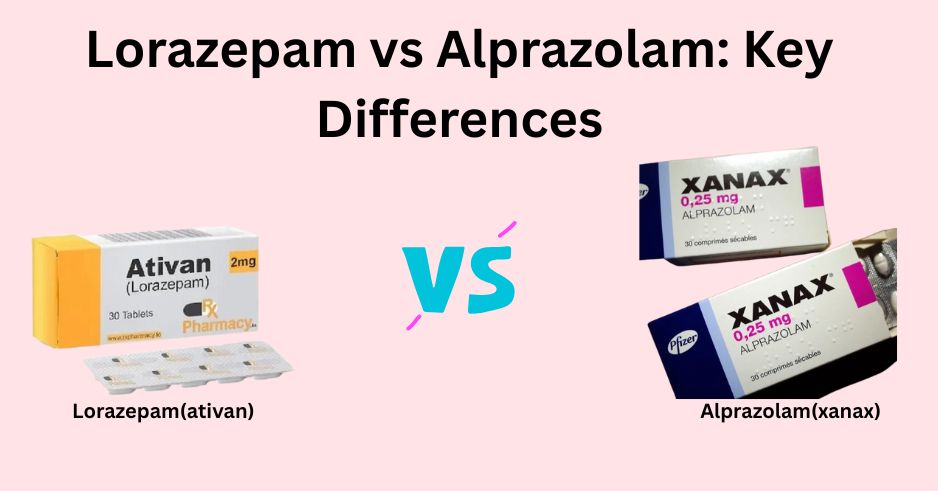
Anxiety disorders are among the most commonly treated mental health conditions, and benzodiazepines are often prescribed for short-term relief of acute anxiety symptoms. Two of the most frequently prescribed medications in this class are lorazepam (Ativan) and alprazolam (Xanax).
While both medications work in similar ways, they differ in onset speed, duration, clinical use, and safety considerations. Understanding these differences can help patients make informed decisions alongside their healthcare provider.
What Are Benzodiazepines?
Lorazepam and alprazolam belong to a class of medications called benzodiazepines, which act on the central nervous system to produce a calming effect.
How Benzodiazepines Work in the Brain
Benzodiazepines enhance the activity of GABA (gamma-aminobutyric acid), a neurotransmitter that slows down excessive brain activity. Increased GABA activity results in:
- Reduced anxiety
- Muscle relaxation
- Sedation
- Decreased panic responses
Because of their fast-acting nature, benzodiazepines are commonly used for short-term or situational anxiety, not long-term daily treatment.
Overview: Lorazepam and Alprazolam
Lorazepam (Ativan)
Lorazepam is often prescribed for:
- Generalized anxiety disorder (GAD)
- Acute anxiety episodes
- Pre-surgical anxiety
- Insomnia related to anxiety
- Seizure management (in hospital settings)
It has a moderate onset and intermediate duration, making it suitable for steady symptom control.
Alprazolam (Xanax)
Alprazolam is commonly prescribed for:
- Panic disorder
- Panic attacks
- Severe anxiety episodes
- Situational anxiety
It has a rapid onset, making it effective for sudden anxiety spikes or panic attacks.
Key Differences Between Lorazepam and Alprazolam
1. Onset of Action
Alprazolam works faster than lorazepam, often producing noticeable effects within 30 minutes.
Lorazepam typically takes 45–60 minutes to reach peak effect.
What this means for patients:
Alprazolam is often preferred for sudden panic attacks, while lorazepam is better suited for ongoing anxiety relief.
2. Duration of Effects
- Lorazepam: Effects last approximately 6–8 hours
- Alprazolam: Effects last approximately 4–6 hours
Lorazepam’s longer duration may reduce the need for frequent dosing, while alprazolam’s shorter duration can lead to more frequent use.
3. Metabolism and Liver Impact
Lorazepam is metabolized through glucuronidation, which is easier on the liver.
Alprazolam is metabolized by the CYP450 enzyme system, which can interact with other medications.
Clinical significance:
Lorazepam is often preferred for older adults or patients with liver impairment.
4. Strength and Potency
Alprazolam is generally considered more potent per milligram than lorazepam.
Approximate equivalence:
- 0.5 mg alprazolam ≈ 1 mg lorazepam
Because of its potency, alprazolam may feel stronger and faster—but also carries a higher risk of dependence.
5. Approved Uses
| Use Case | Lorazepam | Alprazolam |
|---|---|---|
| General anxiety | ✅ | ✅ |
| Panic disorder | ⚠️ | ✅ |
| Insomnia (short-term) | ✅ | ⚠️ |
| Pre-procedure anxiety | ✅ | ❌ |
| Hospital seizure control | ✅ | ❌ |
Side Effects: What to Expect
Common Side Effects (Both Medications)
- Drowsiness
- Dizziness
- Fatigue
- Impaired coordination
- Memory difficulties
Alprazolam-Specific Considerations
- Rebound anxiety between doses
- Stronger withdrawal symptoms
- Higher risk of misuse
Lorazepam-Specific Considerations
- Longer sedation
- Less intense rebound anxiety
Side effects are typically dose-dependent and improve with proper medical supervision.
Dependence and Withdrawal Risks
Both lorazepam and alprazolam can cause physical dependence, especially with:
- Daily use
- High doses
- Long-term treatment
Withdrawal Symptoms May Include:
- Increased anxiety
- Insomnia
- Irritability
- Tremors
- In severe cases, seizures
Alprazolam is associated with more intense withdrawal symptoms due to its short half-life.
Important: Never stop benzodiazepines abruptly. Tapering under medical supervision is essential.
Which Medication Is Right for You?
The choice between lorazepam and alprazolam depends on several factors:
Lorazepam May Be Preferred If:
- You need longer-lasting anxiety relief
- You have liver concerns
- You want a lower rebound risk
- You experience generalized anxiety
Alprazolam May Be Preferred If:
- You experience sudden panic attacks
- You need rapid symptom relief
- Your anxiety is episodic rather than constant
Only a licensed healthcare provider can determine the most appropriate option.
Benzodiazepines vs Long-Term Anxiety Treatment
While effective, benzodiazepines are not first-line treatments for long-term anxiety management.
Most providers recommend:
- SSRIs or SNRIs for daily control
- Benzodiazepines for short-term or emergency use
- Therapy (especially CBT) alongside medication
This combined approach reduces dependency risks and improves long-term outcomes.
Telehealth and Benzodiazepine Management
Telehealth has improved access to anxiety care by offering:
- Online mental health consultations
- Ongoing medication monitoring
- Secure digital prescriptions
- Privacy-focused care
Final Thoughts
Both lorazepam and alprazolam are effective anti-anxiety medications, but they serve different clinical purposes. Alprazolam offers rapid relief for panic attacks, while lorazepam provides steadier, longer-lasting anxiety control with fewer rebound effects.
Understanding their differences empowers patients to have informed conversations with healthcare providers and choose safer, more effective anxiety treatment plans.
If you’d like next:
- Medication comparison schema markup
- Internal linking to SSRI or anxiety pillar pages
- Luxury digital health tone